
Tel/WA:
Tel/WA:

PV Series-Parallel Connection and Its Relationship with Inverter Voltage and Current
Photovoltaic (PV) systems rely on the rational connection of solar modules and the efficient conversion of inverters to maximize power generation. The series and parallel connection of PV modules directly determines the input voltage and current of the inverter, while the inverter, as the "heart" of the PV system, adjusts and converts these electrical parameters to meet grid connection requirements. Understanding the relationship between PV series-parallel connection and inverter voltage/current is crucial for optimizing system design, improving power generation efficiency, and ensuring safe and stable operation. This article systematically explains the principles of PV series-parallel connection, the working characteristics of inverters, and their intrinsic parameter relationships.
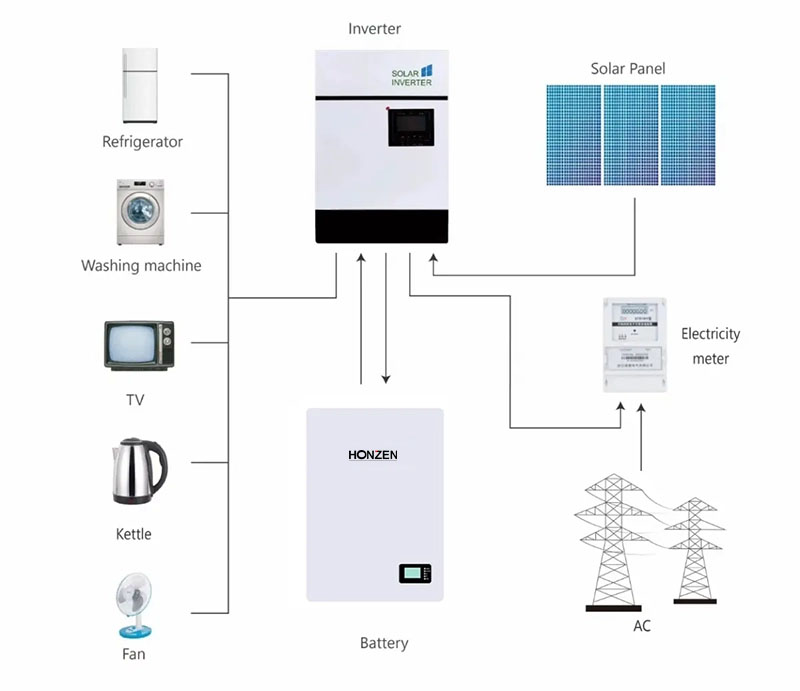
PV modules are the basic power generation units, and their series and parallel connection is designed to adjust the total voltage and current of the PV string or array to match the input requirements of the inverter. In practical applications, a single PV module has a limited output voltage (usually 30-40V for monocrystalline silicon modules) and current (around 8-10A), which is far from meeting the input voltage and power requirements of the inverter. Therefore, combining multiple modules in series and parallel is necessary to form a PV array with appropriate parameters.
Series connection of PV modules is mainly used to increase the total output voltage. When modules are connected in series, the positive terminal of one module is connected to the negative terminal of another, and the total voltage of the series string is the sum of the open-circuit voltage (Voc) of each individual module. For example, if 10 modules with a Voc of 36V are connected in series, the total Voc of the string will be 360V. However, the total current of the series string is equal to the maximum short-circuit current (Isc) of a single module, as the current in a series circuit remains consistent. It should be noted that in series connection, the performance of the entire string is limited by the module with the lowest performance (such as a shaded or faulty module), which may cause a significant drop in the total power output—a phenomenon known as the "shading effect."
Parallel connection of PV modules, by contrast, is intended to increase the total output current. When modules are connected in parallel, the positive terminals of all modules are connected together, and the negative terminals are also connected together. The total current of the parallel array is the sum of the Isc of each module, while the total voltage remains equal to the Voc of a single module. For instance, if 5 modules with an Isc of 9A are connected in parallel, the total Isc of the array will be 45A. Parallel connection can mitigate the impact of shading to a certain extent: if one module is shaded, only the current of that branch decreases, and the other branches can still operate normally, reducing the overall power loss.
In practical PV system design, series and parallel connections are often combined to form a PV array that meets the inverter’s input parameters. For example, several modules are connected in series to form a string with the required voltage, and then multiple such strings are connected in parallel to achieve the required current and total power. The key is to ensure that the total voltage and current of the array fall within the inverter’s input range—including the maximum input voltage, minimum input voltage, and maximum input current—otherwise, the inverter may fail to work normally or even be damaged.
The inverter is responsible for converting the direct current (DC) generated by the PV array into alternating current (AC) that can be connected to the grid or used by loads. Its operation is closely related to the input voltage and current from the PV array, and it has strict requirements for the input parameters. The input voltage range of the inverter is a critical index: if the input voltage is lower than the minimum input voltage, the inverter cannot start; if it exceeds the maximum input voltage, the inverter will trigger overvoltage protection and shut down to avoid damage.
The relationship between PV series-parallel connection and inverter voltage is direct and decisive. The number of modules in series determines the total voltage of the PV string, which must be within the inverter’s input voltage range. For example, if an inverter has a minimum input voltage of 200V and a maximum input voltage of 1000V, the series string voltage (under standard test conditions) should be between these two values. In cold weather, the Voc of PV modules will increase (by approximately 0.35% per °C decrease), so the number of series modules must be calculated with this temperature coefficient in mind to avoid overvoltage in low-temperature environments.
In terms of current, the total current of the PV array (after parallel connection of multiple strings) must not exceed the maximum input current of the inverter. If the total current is too large, the inverter will trigger overcurrent protection, leading to shutdown. At the same time, the inverter’s maximum input power determines the total power of the PV array: the product of the input voltage and current of the array should not exceed the inverter’s rated input power, otherwise, the inverter will limit the power output, resulting in power waste.
Another important aspect is the maximum power point tracking (MPPT) function of the inverter. The MPPT function adjusts the working voltage and current of the PV array to ensure that the array operates at the maximum power point (MPP) at all times. The series-parallel connection of PV modules affects the MPP range of the array: a reasonable connection method can expand the MPP voltage range, making it easier for the inverter’s MPPT to track the optimal working point, thereby improving the overall power generation efficiency of the system. If the series-parallel connection is unreasonable, the MPPT may fail to track the MPP effectively, leading to reduced power output.
In practical applications, improper series-parallel connection can cause various problems. For example, too many modules in series may lead to overvoltage in low temperatures, damaging the inverter; too few modules in series may result in the input voltage being lower than the inverter’s minimum requirement, making the inverter unable to work. Similarly, too many parallel strings may cause the input current to exceed the inverter’s limit, while too few parallel strings may not make full use of the inverter’s capacity, resulting in low utilization efficiency.
To sum up, the series-parallel connection of PV modules and the voltage-current parameters of the inverter are closely interconnected and mutually restrictive. The series connection increases the voltage, the parallel connection increases the current, and the combination of the two forms a PV array that matches the inverter’s input requirements. A reasonable design of the series-parallel connection not only ensures the safe and stable operation of the inverter but also maximizes the power generation efficiency of the PV system. With the continuous development of PV technology, the coordination between module connection and inverter performance will become more refined, laying a solid foundation for the large-scale application of solar energy.
|(注:文档部分内容可能由 AI 生成)
HONZEN TECH

WeChat QR code
WeChat ID:15366425298